
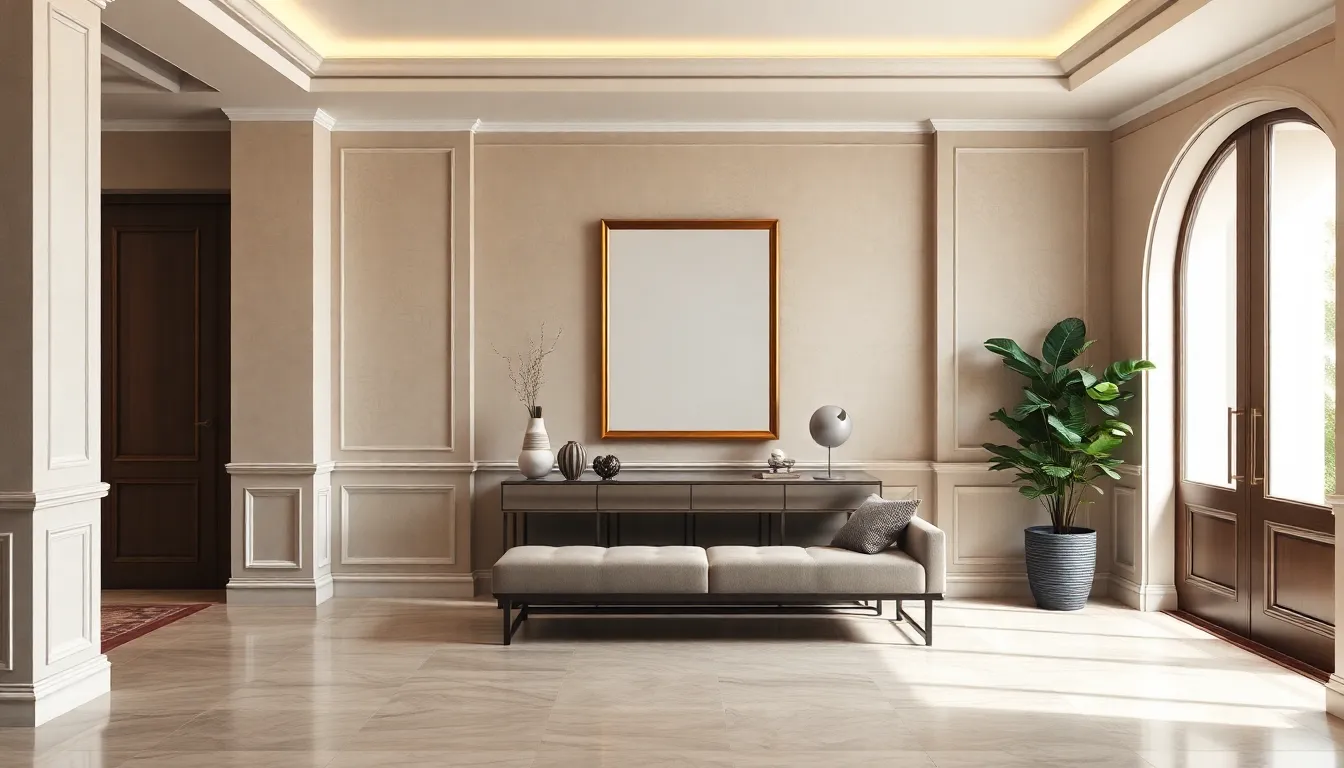
Table of Contents:
Choose a Refined Color Palette for a Luxurious First Impression
A refined entryway palette should feel calm, layered, and deliberate from the moment the door opens. Start with one architectural base shade, then add two supporting tones and a restrained accent. This approach prevents the space from looking flat or overly decorated.
Warm neutrals are a reliable foundation. Soft ivory, mushroom, taupe, greige, and muted stone work well because they reflect changing daylight without appearing stark. In rooms with little natural light, avoid cool blue-gray paint; it can make the entrance feel colder than it is. Instead, choose a shade with warm red, yellow, or brown undertones.
For a more dramatic effect, use deep olive, ink blue, charcoal, or chocolate brown on the walls. Dark color can make a narrow entrance feel intimate rather than cramped, especially when the ceiling and trim remain slightly lighter. A useful rule is to keep the ceiling within one or two tones of the wall. Strong contrast above the eye line may divide the room visually.
Luxury comes from tonal variation, not from using many colors. Pair a matte wall with satin-painted trim, a honed stone surface, or softly textured wallpaper. These subtle shifts catch light in different ways and give a monochrome scheme more depth. Glossy paint is best used in small doses, since it can expose uneven walls and create harsh reflections.
- Quiet classic: ivory, warm taupe, aged brass, and walnut brown.
- Contemporary: pale greige, charcoal, blackened metal, and natural oak.
- Jewel-toned: dusty rose, aubergine, muted bronze, and deep brown.
- Organic: clay, olive, parchment, and soft black.
Test large paint samples on more than one wall. Check them in morning light, at dusk, and under artificial lighting. Color can shift sharply across a foyer, particularly beside a glazed front door. Leave each sample in place for at least 24 hours before deciding; a tiny card is rarely enough to judge the final mood.
Keep the strongest color at eye level or below. A painted lower section, for example, can add depth while a paler upper wall preserves airiness. This trick is especially effective where visitors pause, remove shoes, or move between the entrance and adjoining rooms. The result feels composed rather than staged.
Anchor the Foyer with a Sculptural Console Table
A sculptural console table gives the foyer a clear visual anchor without making the space feel crowded. Look for a piece with a distinctive silhouette: a curved apron, fluted sides, a cantilevered top, or a stone slab supported by a geometric base. The form should feel intentional even when the surface is almost bare.
Scale matters more than price. Leave about 90 centimetres of clear walking space in front of the table where possible. For a comfortable proportion, choose a height close to 75 to 85 centimetres, then match the width to the wall rather than filling every available inch. A console that is too small looks lost; one that is too deep turns the entrance into an obstacle course.
Measure the door swing, skirting boards, radiators, and nearby passageways before buying. A depth of 25 to 35 centimetres often works well in a compact foyer. In a generous hall, a deeper piece can provide stronger presence, but its corners should not interrupt the natural route through the home. Practical luxury remains practical.
Choose materials that bring contrast without creating visual noise. Veined marble beside dark timber feels architectural, while brushed metal and smoked glass create a sharper modern mood. Travertine, richly stained oak, and textured lacquer offer warmth with a quieter character. Inspect stone samples in person when possible, because veining and undertones can vary considerably between slabs.
Use the console as a controlled landing point for daily items. A shallow tray can hold keys, while one drawer keeps chargers, sunglasses, and mail out of sight. If the table has no storage, add a discreet lidded box beneath it, leaving enough open space for the design to breathe.
- Keep decorative objects in groups of three or five, varying their height.
- Place the tallest object slightly off centre rather than directly in the middle.
- Leave at least one-third of the tabletop visibly clear.
- Use felt pads beneath ceramics and stone to protect the finish.
- Secure unstable objects if children or pets pass through the foyer.
For a narrow entrance, a floating console can be especially effective. Wall mounting exposes more floor, makes cleaning easier, and gives the furniture a lighter profile. Check the wall construction first: masonry, studs, and plasterboard require different fixings. A well-designed entrance should remain safe during everyday use.
Use Oversized Mirrors to Add Light and Grandeur
An oversized mirror can amplify daylight and give an entryway a stronger sense of scale. Choose one that occupies roughly two-thirds of the available wall width, while leaving enough space around the frame for the architecture to remain visible. A tall design can also emphasize ceiling height and create a more graceful vertical line.
Use the mirror to reflect something worth seeing. A glazed door, a garden view, a distinctive staircase, or a carefully composed wall can add depth to the foyer. Avoid positioning it opposite clutter, open storage, or a blank utility area. Reflection doubles whatever sits in front of it, for better or worse.
Frame choice sets the tone. Antiqued brass brings warmth, dark timber feels established, and a slim black frame suits a crisp contemporary interior. For a quieter look, choose a frameless or softly bevelled design. Bevelled edges catch moving light and add a fine, almost jewellery-like detail without demanding attention.
In a compact entrance, a full-height mirror can create the illusion of an adjoining room. Mount it securely rather than simply leaning it against the wall, especially near the front door or along a busy route. Use suitable anchors for the wall type, and follow the manufacturer’s weight rating. Safety belongs to the design.
Consider the glass finish before making a choice. Clear glass gives the sharpest reflection, smoked glass adds mood, and lightly antiqued glass softens the effect in a traditional setting. Strong distortion may look artistic in a showroom but can become distracting in daily use, so inspect the reflection from several angles.
- Place the centre of the mirror near average eye level, about 150 to 165 centimetres from the floor.
- Keep a clear zone around the frame so the piece reads as architecture, not clutter.
- Check sightlines from the doorway, stairs, and adjoining rooms before fixing it in place.
- Use safety-backed glass in busy homes or areas where impact is possible.
A mirror should support the entryway’s composition, not act as a substitute for one. Its best effect is subtle: the room appears brighter, longer, and more generous, while the object itself remains quietly commanding.
Layer Statement Lighting for a Warm, Elegant Glow
Layered lighting gives an entryway warmth, depth, and control. Instead of relying on one bright ceiling fixture, combine a central source with softer illumination at lower and mid-levels. The space then feels welcoming at night and remains easy to navigate when hands are full.
Begin with the room’s proportions. A pendant or chandelier should suit the ceiling height and leave generous head clearance above the main walking path. In a standard-height room, a low-profile flush mount or semi-flush fitting is often safer. In a tall foyer, a sculptural pendant can fill the vertical volume without needing extra decoration.
Use wall lights to create a gentle wash across the architecture. Opal glass diffusers reduce glare, while directional fittings can highlight texture, artwork, or a distinctive doorway. Install pairs with care: symmetry feels formal, but an intentionally offset arrangement can look more relaxed in an unconventional plan.
Light colour affects the entire mood. A colour temperature near 2700K usually feels warm and residential. Around 3000K gives a cleaner appearance while remaining comfortable. Avoid mixing strongly different temperatures in the same sightline; the foyer may then look patchy rather than polished. High colour-rendering lamps, ideally with a CRI of 90 or above, show finishes and skin tones more naturally.
- Ambient light: provides the general level needed for safe movement.
- Accent light: draws attention to texture, art, or architectural features.
- Decorative light: acts as a visible design element, even when switched off.
- Guidance light: helps reveal steps, thresholds, and changes in floor level.
Connect the layers to separate controls or dimmers. This lets you create a brighter setting for arrivals, a softer setting for evening gatherings, and a low-level glow during the night. Smart controls can add convenience, but good placement and glare control matter more than gadgets.
Keep light sources out of direct eye lines where possible. Exposed bulbs can feel harsh when visitors look toward the ceiling from the doorway. Frosted glass, shaded fixtures, and concealed LED strips produce a more composed effect. A little shadow is useful, too; an entryway with no tonal variation can feel flat and overly commercial.
Select Durable Rugs That Look Rich and Welcome Guests
A foyer rug must handle grit, damp shoes, and frequent traffic without looking utilitarian. The best choices combine a dense construction with a surface that hides small marks. Flatweaves, low-pile wool, and carefully made performance fibres are usually more practical than deep shag, which traps debris and catches on footwear.
Choose the material according to the entrance’s exposure. Wool naturally resists crushing and can be spot-cleaned, while solution-dyed synthetics cope well with moisture, pets, and busy households. Silk and viscose may look luminous, but they are poor choices near an exterior door because water and abrasion can leave permanent changes in the pile.
Proportion also affects both comfort and appearance. A runner should leave a visible strip of flooring along its sides, while a larger rug can define the arrival zone in a generous hall. Keep the front edge far enough from the door for it to open freely. A rug that bunches at the threshold quickly loses its polished effect.
Colour and pattern can perform useful work. Heathered neutrals, faded geometrics, and small-scale motifs disguise dust more effectively than a solid pale surface. Deep colour is not always the answer: it may show lint, salt, and pet hair. Pick a pattern that relates to the home’s architecture but does not compete with the focal features already in the entrance.
Pay attention to the underside. A quality non-slip pad keeps the rug stable, protects the floor, and adds a little cushioning underfoot. Avoid rubber-backed products on delicate timber unless the manufacturer confirms compatibility, as some backings can trap moisture or mark the finish.
- High traffic: select a low pile, tight weave, and strong edge binding.
- Wet climate: favour washable or quick-drying fibres and allow space for air to circulate.
- Pets: avoid looped constructions that can catch claws.
- Light floors: choose medium-value colour with a broken pattern to reduce visible grit.
- Hard flooring: use a dense pad to soften footsteps and prevent movement.
Vacuum both sides when possible, rotate the rug every few months, and treat spills quickly by blotting rather than rubbing. Follow the care label for professional cleaning. A well-maintained floor covering quietly protects the surface beneath it while making the entrance feel finished.
Style Art, Vases, and Greenery with Intent
Art, vessels, and plants should make the entryway feel considered, not crowded. Select each piece for a clear reason: it may introduce scale, echo an architectural line, soften a hard surface, or offer a glimpse of the household’s character. A small collection with visual purpose feels more luxurious than a shelf full of attractive but unrelated objects.
Choose artwork according to the viewing distance. A bold abstract canvas can hold its own in a deep foyer, while a finely detailed drawing works better where guests stand close. As a practical guide, the artwork should occupy around two-thirds of the visual width above the console, unless the wall has a strong architectural feature that changes the balance.
Use the entrance to establish a restrained art language. Pair a contemporary print with an antique frame, or place a sculptural work beside a flat, graphic image. Similar proportions can link unlike styles. Repeated materials help, too: a dark frame, a bronze vessel, and a small black stone object can create cohesion without forming a matching set.
Vases provide shape even when they are empty. Select one with a narrow neck for delicate branches, a broad opening for generous foliage, or an irregular profile as a quiet focal point. Handmade ceramics, carved stone, and mouth-blown glass bring small variations that mass-produced objects often lack. They need not be expensive; they need to feel tactile and well chosen.
Bring in greenery with an honest view of the conditions. A north-facing entrance may suit a cast-iron plant or a zz plant, while bright filtered light can support an olive tree or kentia palm. Avoid placing living plants directly against a cold draught or beside a radiator. A healthy plant always looks more refined than a fashionable one that is struggling.
- For height: use a single branch arrangement or a narrow plant with an upright habit.
- For softness: choose rounded leaves or loose, asymmetrical stems.
- For a modern mood: select one sculptural vessel and leave its surroundings quiet.
- For seasonal change: replace fresh branches rather than adding more permanent objects.
Keep arrangements below key sightlines when the foyer is narrow. Tall objects placed near the door can interrupt movement and make the entrance feel fussy. In a wider hall, a generous arrangement can mark the transition into the home, particularly when its silhouette is visible from another room.
Finally, edit from every approach. View the composition from outside the front door, from the staircase, and from the main living area. Remove anything that competes with the architecture or repeats a nearby shape too closely. The most sophisticated display often has one less thing in it.
Create a Sophisticated Modern Home Entrance
A sophisticated modern entrance begins with a clear route from the front door into the home. Keep the central path open and let the architecture lead. Flush thresholds, concealed wiring, and carefully aligned door hardware create a calm visual rhythm before decorative details even enter the picture.
Modern luxury also depends on continuity. Carry one material or design line from the exterior into the foyer, such as the same stone tone, timber finish, or metal detail. This makes the transition feel deliberate rather than abrupt. It can be a small echo, not a perfect match.
Choose doors and hardware with the same care as the room itself. A wide pivot door can suit a generous contemporary façade, while a slim steel-framed door gives a smaller entrance a crisp architectural edge. Lever handles should feel solid in the hand, and hinges, locks, and closers should operate quietly. Tiny sounds can undermine an otherwise elevated setting.
Concealed storage keeps modern entrances visually quiet. Plan a dedicated place for umbrellas, parcels, shoes, and seasonal coats instead of allowing these items to collect near the threshold. Ventilated cabinetry is useful for footwear, while a narrow drawer can hold access cards and everyday essentials. The goal is not an empty room; it is a room where daily life has a discreet address.
Use vertical lines to make the entrance feel taller and horizontal lines to make it feel wider. Full-height panelling, tall door casings, or a continuous built-in unit can strengthen a narrow volume. In a broad foyer, a low architectural bench or a long timber detail can provide visual calm without breaking the clean geometry.
- For a crisp look: use flush doors, shadow gaps, and minimal visible hardware.
- For warmth: combine one natural material with smooth painted surfaces.
- For family life: include closed compartments and a hard-wearing lower zone.
- For an older property: preserve original mouldings while simplifying newer additions.
Do not force every modern feature into the space. A visible radiator, an honest seam, or a slightly imperfect timber grain may give the entrance more character than a seamless imitation. Sophistication comes from resolving practical needs with restraint, so the foyer feels effortless rather than engineered.
Before final installation, review the design from the street, the doorstep, and the first room beyond the entrance. The exterior view should feel inviting, while the interior view should offer a composed glimpse of what follows. That sequence is the real signature of a successful modern home entrance.
Make a Grand Foyer Feel Balanced and Personal
A grand foyer feels luxurious when its generous scale has a clear sense of order. Start by defining zones rather than filling the room. A central arrival area, a place to pause, and a visible route toward the next room can make a vast space feel composed and easy to read.
Use architectural features as natural boundaries. A change in ceiling height, a column, a broad opening, or a staircase can separate functions without adding partitions. Keep the main circulation line generous; in a busy household, around 120 centimetres usually allows two people to pass comfortably.
Large foyers benefit from visual hierarchy. Give one feature the leading role, such as a sweeping staircase, a finely detailed door, or a striking piece of sculpture. Let secondary elements support it. When every object competes for attention, grandeur turns into noise rather quickly.
Personal character should come through in layers that have a story. Display a travel find, a family photograph in an archival frame, or a piece made by a local craftsperson. Mix periods with discipline. One historic object can give a new interior soul; a crowded collection can make the entrance feel like storage.
Consider acoustics, an often-overlooked part of elegance. High ceilings and hard surfaces can create a sharp echo. A fabric wall panel, a lined curtain near a glazed opening, or an upholstered seat can soften the sound without changing the room’s style. This matters most when the foyer opens directly into several rooms.
- Define one primary axis: guide the eye toward the staircase, garden, or principal room.
- Repeat one proportion: echo the height or width of a key architectural feature elsewhere.
- Leave breathing room: empty space gives important objects greater presence.
- Add a personal trace: choose something meaningful, not merely decorative.
- Check the acoustics: reduce echo before adding more visual detail.
Balance does not require perfect symmetry. A substantial sculpture on one side may be offset by a taller architectural opening or a quiet grouping on the other. What matters is visual weight: dark, dense, or highly textured elements carry more force than pale, open ones.
Finally, design for different moments. The foyer should look impressive when guests arrive, yet remain comfortable during an ordinary weekday. A grand room becomes truly personal when it supports real rituals, welcomes movement, and still feels like home after the last visitor has left.
Maximize Style in a Small Foyer
A small foyer can feel luxurious when every centimetre has a clear job. Begin by measuring the usable width after door clearance, trim, and walking space are accounted for. This prevents attractive furniture from narrowing the route and helps you plan with precision rather than guesswork.
Use the vertical plane for function. A slim peg rail, recessed shelf, or shallow wall cabinet can hold everyday items without consuming floor area. Keep the depth modest—around 15 to 20 centimetres for light storage—unless the unit sits well outside the door swing and main path.
Built-in joinery is especially valuable in compact entrances. A full-height cabinet can combine a coat cupboard, shoe drawers, and a small perch in one uninterrupted form. Choose doors that sit flush with the wall, or paint the joinery to match it, so storage reads as architecture instead of a collection of separate pieces.
Consider a narrow ledge instead of conventional furniture. It can hold a small dish, access cards, or a single object while leaving the floor open. A fold-down seat offers a place to put on shoes, then disappears against the wall when not in use. Clever, but not gimmicky.
Use one strong finish to create visual confidence. A slab of richly grained timber, a hand-trowelled plaster surface, or a slim stone shelf can give the room character without requiring many accessories. In a tiny foyer, material quality is often more noticeable than quantity.
- Keep the doorway clear: allow the door to open fully without striking furniture or storage.
- Use hidden capacity: assign separate compartments for coats, shoes, keys, and deliveries.
- Choose slim profiles: wall-mounted elements preserve valuable floor area.
- Protect corners: use rounded edges where the entrance is especially tight.
- Plan maintenance: select finishes that can handle fingerprints and occasional knocks.
Do not overload a small foyer with tiny decorative objects. They create visual static and make cleaning awkward. One carefully selected detail, such as a carved hook set or a distinctive door number, can provide more impact than a busy arrangement.
Finally, make the entrance serve the way you live. If parcels arrive often, create a discreet drop zone. If guests remove shoes, provide a place to sit. A compact foyer feels genuinely sophisticated when its practical answers are almost invisible.
Design a Polished Mudroom with Concealed Storage
A polished mudroom should hide household mess without hiding how the space works. Plan it around the arrival sequence: wet outerwear first, shoes below, bags at hand height, and clean items farther from the door. This simple zoning prevents damp coats and outdoor grit from spreading through the home.
Use full-height cabinetry with distinct internal compartments. A ventilated section can hold coats, while adjustable shelves accommodate boots, helmets, or sports equipment. Add a drip tray beneath footwear storage and choose a removable, waterproof liner. These small details protect the cabinet and make maintenance far less tedious.
Concealed storage looks most refined when its doors align with the architecture. Slab fronts create a quiet contemporary surface; framed fronts suit a more traditional house. Recessed pulls or touch latches reduce visual clutter, but include a robust handle where doors are heavy or frequently used. Beauty should not make daily access awkward.
Materials need to tolerate moisture and impact. Porcelain tile, sealed stone, compact laminate, and moisture-resistant paint are sensible choices for the lower zone. Avoid untreated timber near dripping footwear. If you use natural wood, seal all exposed edges, especially around benches and cabinet bases.
Give each household member a defined place. Numbered cubbies, colour-coded interiors, or discreet nameplates can prevent the familiar morning scramble. For children, position hooks between 90 and 120 centimetres above the floor; adult storage can sit higher. A hidden drawer for keys and access cards keeps small essentials from migrating across the house.
- Wet zone: place washable surfaces and drainage closest to the exterior door.
- Dry zone: store folded items and delicate accessories away from splash and grit.
- Utility zone: reserve space for cleaning cloths, pet leads, and reusable bags.
- Airflow: allow ventilation behind enclosed coat storage to reduce damp odours.
- Maintenance: use removable trays and cleanable liners where dirt collects.
Do not seal every compartment tightly. Wet coats need air, and boots need time to dry. Discreet ventilation slots, perforated panels, or a small extraction fan can help in a poorly ventilated room. Check local electrical and building requirements before adding powered equipment near water.
Finish the room with one deliberate comfort feature, such as a tailored cushion on the changing bench or a washable runner in a secondary colour. The mudroom may be hardworking, but it should still feel connected to the home. When storage is quiet, durable, and easy to use, sophistication appears almost effortlessly.
Example: A Complete Luxury Entryway Look
Picture a 2.4-metre-wide foyer in a city townhouse. The front door opens onto a restrained composition: warm limestone underfoot, pale plaster walls, and a dark timber door that gives the entrance a firm architectural edge. The palette is quiet, so the quality of each finish can speak clearly.
Along the longest wall sits a 150-centimetre floating cabinet with four flush fronts. Two compartments store shoes, one holds umbrellas and shopping bags, and the final section conceals a charging drawer. A slim quartz shelf above it provides a landing place for keys without becoming a display ledge.
Opposite the cabinet, a narrow upholstered bench allows visitors to change footwear. Its seat is covered in a tightly woven, stain-resistant fabric, while the base repeats the dark timber of the front door. This small echo links the entrance together without turning the room into a matched furniture set.
The ceiling carries a compact sculptural pendant with a dimmable driver. Two low-level wall lights add a soft evening marker near the passage into the living area. Their circuits are separate, so the owners can use a gentle night setting without lighting the entire foyer.
One framed photograph occupies the end wall. It shows a nearby coastal landscape and gives the room a personal point of view. Beneath it, a shallow ceramic bowl holds keys. Nothing else is needed there. The restraint is intentional, and it keeps the daily routine visible but orderly.
The final detail is a discreet scent-free approach to comfort: good ventilation, smooth door hardware, and a quiet closer. These features rarely appear in photographs, yet they shape the experience every time someone arrives. Luxury is not only what guests notice; it is also what works without asking for attention.
- Architectural base: limestone, plaster, and dark timber.
- Storage plan: concealed compartments for shoes, bags, umbrellas, and charging.
- Personal note: one meaningful photograph rather than a crowded gallery.
- Daily comfort: a compact bench, clear access, and silent hardware.
- Evening mood: dimmable light with separate controls for gentle transitions.
This scheme can be adapted to a smaller apartment by replacing the cabinet with a 20-centimetre-deep wall unit and using a folding seat. In a larger home, the same logic can expand into a full-height storage wall. The ingredients change with the floor plan; the discipline of editing remains the same.
Conclusion: Edit Every Detail for Lasting Sophistication
Lasting sophistication comes from decisions that remain convincing after the first impression has passed. Before finishing the foyer, walk through it at different times of day and notice what feels unnecessary, fragile, or difficult to maintain. A beautiful entrance should age with grace, not depend on constant arranging.
Review the details at three levels: appearance, performance, and repair. Check whether surfaces can be cleaned, finishes can be touched up, and replacement parts are available. Keep records of paint colours, fabric codes, stone sealants, and electrical specifications. This small archive can save time years later, especially after a renovation or accidental damage.
Choose longevity over novelty. A trend may photograph well for a season, while sound proportions, honest materials, and comfortable movement remain persuasive for decades. If a decorative decision needs frequent explanation, it may not belong in the entrance. The strongest rooms usually feel clear before they feel clever.
- Remove: anything that blocks movement or has no useful visual role.
- Refine: finishes that clash under natural and artificial light.
- Protect: vulnerable surfaces with suitable sealers and discreet safeguards.
- Document: measurements, product details, and maintenance instructions.
- Reassess: the room after several weeks of ordinary use.
Let the foyer change slowly. Rotate seasonal objects, repair worn details early, and resist replacing a well-made element simply because a new trend appears. This creates a sense of continuity that no shopping list can manufacture.
Ultimately, luxury entryway decor is an exercise in proportion, restraint, and care. When every choice supports the home’s architecture and the household’s daily rhythm, sophistication becomes quiet, useful, and remarkably enduring.
Frequently Asked Questions About Sophisticated Entryway Design
How can I make an entryway look luxurious?
Create a polished foundation with a refined color palette, high-quality materials, layered lighting, and carefully selected furniture. A sculptural console, an oversized mirror, durable flooring, and concealed storage can add elegance without overcrowding the space.
What furniture works best in a luxury entryway?
A well-proportioned console table is a versatile focal point, while a slim bench can provide practical seating. In smaller entryways, floating consoles, wall-mounted shelves, and built-in cabinets preserve floor space while maintaining a sophisticated appearance.
Which lighting is suitable for an elegant foyer?
Use layered lighting that combines ambient, accent, and decorative sources. A suitable pendant or chandelier can provide a focal point, while wall lights and dimmable fixtures create a warm, flexible atmosphere. Light around 2700K to 3000K generally feels comfortable and inviting.
How do I decorate a small entryway luxuriously?
How do I decorate a small entryway luxuriously?
Use vertical storage, slim furniture, an oversized mirror, and one distinctive material or decorative feature. Keep the doorway and walking route clear, select wall-mounted elements where possible, and avoid too many small accessories that can make the space feel cluttered.
How can a mudroom remain stylish and practical?
Combine concealed, full-height storage with durable moisture-resistant materials. Provide dedicated areas for coats, shoes, bags, and wet items, while using ventilation, removable trays, and easy-to-clean surfaces to keep the room organized and refined.