
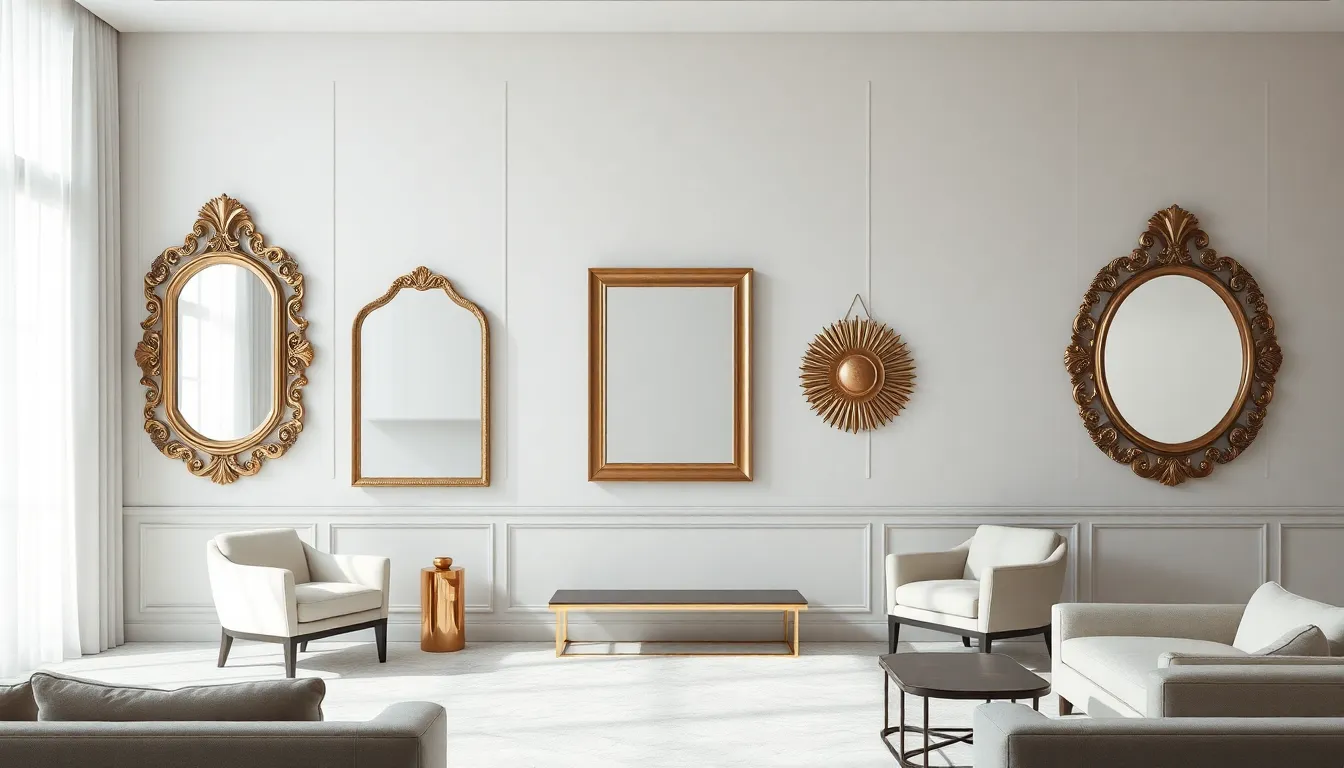
Table of Contents:
Choose Luxury Decorative Mirrors by Room and Wall Size
Choosing luxury decorative mirrors starts with the room, not the frame. Measure the available wall area first, then consider what the mirror should do: fill a narrow gap, balance a broad piece of furniture, or bring more daylight into a dim zone.
For a calm result, let the mirror occupy about two-thirds to three-quarters of the furniture width beneath it. Above a console, a 30-inch mirror often suits a 42-inch console, while a 36-inch mirror can anchor a 54-inch piece. These proportions are guidelines, not rules; an oversized design can feel intentional when the surrounding wall has enough breathing room.
Match the Mirror to the Room’s Scale
Small rooms benefit from compact round or vertical mirrors. Their curved edges soften tight layouts, and their height can draw the eye upward. In a large living room, one small mirror may look lost. Choose a wider design, a tall architectural shape, or a pair arranged with measured spacing.
- Entryways: Choose a 24- to 36-inch-wide mirror, leaving clear space for coats, doors, and movement.
- Living rooms: Select a mirror that relates to the sofa, console, or fireplace rather than the empty wall alone.
- Dining rooms: Use a broad horizontal piece to echo the table and reflect candlelight or pendant light.
- Bedrooms: A tall mirror works well beside a wardrobe, while a smaller piece suits a dressing area.
Measure the Wall Before You Shop
Record the wall width, ceiling height, furniture width, and the distance between the floor and the intended lower edge. Mark the proposed outline with painter’s tape. This simple step reveals whether the piece feels elegant or, frankly, a bit too hungry for attention.
Allow at least 3 to 6 inches of visual space around a framed mirror when it hangs above furniture. For a gallery-style grouping, keep gaps consistent at roughly 2 to 4 inches. Check door swings, switches, vents, and artwork nearby. A beautiful mirror cannot correct a cramped installation.
Choose Lillian August Luxury Wall Mirrors with Purpose
Lillian August luxury wall mirrors suit interiors built around layered furniture and collected detail. Consider the relationship between the mirror and nearby consoles, cabinets, accent chairs, or lighting. A refined frame can connect separate materials, while a quieter design lets an ornate room breathe.
Before ordering, verify the exact width, height, depth, weight, mounting method, and glass type. For heavy mirrors, identify the wall construction and use suitable anchors or professional installation. On drywall, the fixing method must match the mirror’s weight; on masonry, use hardware rated for that surface.
Use Shape, Frame, and Finish to Define Your Style
Luxury decorative mirrors gain their character from three choices: silhouette, frame, and surface finish. Treat these details as part of the room’s visual language. A mirror should not merely fill a blank wall; it should echo the shapes, materials, and mood already present.
Round designs soften rooms with strong lines. Arched mirrors add a quiet architectural note, while rectangular forms feel crisp and tailored. Organic outlines bring a more relaxed, collected character. For a bold interior, an unusual asymmetrical shape can act like sculpture rather than simple wall décor.
- Round: Best for softening angular furniture and formal layouts.
- Arch: Useful when you want vertical movement and a graceful architectural cue.
- Rectangle: A dependable choice for structured, contemporary interiors.
- Organic: Adds visual looseness to rooms with polished materials or strict geometry.
The frame sets the mirror’s emotional temperature. A thin metal edge feels restrained and modern. Carved wood brings warmth and tactility. Antiqued finishes suggest history, while lacquered surfaces look cleaner and more graphic. In Lillian August Luxury Wall Mirrors, consider whether the frame should quietly support the scheme or become its central punctuation mark.
Finish matters just as much. Brushed brass introduces soft golden warmth without the sharp shine of polished metal. Blackened steel creates contrast and can ground pale walls. Silver leaf catches changing daylight, whereas aged bronze feels deeper and more atmospheric. Natural wood works especially well with linen, stone, leather, and other tactile materials.
Use contrast with care. A dark frame against a light wall reads clearly from across the room; a pale frame on a similar wall creates a subtler, almost misty effect. If several finishes already compete nearby, choose a mirror with one linking tone rather than adding another unrelated accent.
Inspect the glass as closely as the frame. High-quality flat glass should provide a clean reflection without visible waviness. For a more private setting, smoked or antiqued glass changes the mood, but it also reduces clarity. That trade-off is worth considering before purchase, especially when the mirror serves a practical purpose.
Place Luxury Wall Mirrors to Reflect Natural and Layered Light
Place luxury wall mirrors where they can capture light, not merely face an empty wall. The most useful reflection may come from a nearby window, a glazed door, or a pale surface outside the camera’s direct view. A perpendicular wall often gives the best result because it receives light from the window and sends it across the room without creating harsh glare.
Avoid placing the mirror directly opposite strong sun unless you want intense brightness, heat, and distracting reflections during part of the day. Watch the space in the morning, at midday, and late afternoon: a wall that looks luminous at 9 a.m. may feel flat by evening. This observation helps you position Lillian August luxury wall mirrors for a longer, more balanced effect.
- North-facing rooms: Reflect warm surfaces, lamps, or light-toned textiles to soften cool daylight.
- South-facing rooms: Angle reflections away from direct sun to reduce glare.
- East-facing rooms: Use morning light for a fresh, bright effect.
- West-facing rooms: Keep late-day reflections controlled, especially near seating or screens.
Layer artificial light around the mirror rather than relying on its reflection alone. Wall sconces placed to either side create even illumination and reduce shadows on the glass. A ceiling pendant can add sparkle, while a concealed lamp or picture light supplies a softer evening glow. Keep bulbs around 2700K to 3000K for a warm residential atmosphere.
Do not aim a spotlight straight at the glass. Direct light toward the wall, frame, or surrounding artwork instead. A broader wash gives the mirror a more settled presence and avoids sharp reflected beams that reveal every fingerprint.
Reflective placement can also alter perceived depth. A mirror facing a bright doorway may make a narrow passage feel more open; one reflecting greenery can introduce movement and color. Avoid reflecting clutter, television screens, or an unedited storage area. Check the reflection from the main seating position and from the room entrance so the sightline shows light, texture, or architecture rather than an awkward slice of ceiling.
Create a Collected Look with Lillian August Luxury Wall Mirrors
Lillian August luxury wall mirrors can give a room the layered character of a collected interior when they connect objects from different periods, materials, and textures. The goal is not to make every piece match, but to create a visual conversation between the mirror, furniture, art, and small decorative objects.
Start with one clear relationship. A mirror with an aged finish may sit comfortably near antique wood, while a restrained frame can calm a group of patterned textiles. Repeat one subtle detail elsewhere—a warm metal note, a curved line, or a similar patina. This link makes the arrangement feel intentional without turning it into a showroom display.
Use the wall around the mirror as part of the composition. A single ceramic vessel, framed print, or sculptural object can support the design, but leave some areas quiet. Collected rooms need pauses. Too many accents compete with the reflection and make the arrangement feel busy rather than rich.
- Layer eras: Pair a classic mirror profile with contemporary seating or a clean-lined cabinet.
- Balance materials: Offset reflective glass with wood, stone, woven fiber, or aged metal.
- Repeat one detail: Echo a curve, tone, or texture once or twice elsewhere in the room.
- Protect visual calm: Keep the objects nearest the mirror simple and purposeful.
The Lillian August range sits within a wider interior language that includes living-room furniture, consoles and cabinets, coffee tables, accent chairs, and lighting. That context matters. A mirror feels more considered when it belongs to the room’s furniture story, not when it appears as an isolated luxury purchase.
For an authentic collected interior, resist buying every accessory from one collection. Mix scale, age, and finish gradually. One unusual object often adds more personality than a shelf full of coordinated pieces.
Style Living Rooms with Mirrors Above Consoles and Sofas
Luxury decorative mirrors work best above consoles and sofas when they strengthen the furniture arrangement instead of floating apart from it. Treat the wall as a visual anchor: the mirror should relate to the main seating line, the console’s center, and the room’s movement path.
Above a console, center the mirror on the furniture rather than on the wall. A slight gap between the console surface and the lower edge keeps the arrangement connected without making it feel cramped. Leave enough clearance for lamps, vases, and everyday use.
Over a sofa, keep the lower edge high enough to protect the glass from heads, cushions, and accidental contact. In rooms with reclining seats, check the sightline from the back cushions before fixing the mount.
- Above a console: Center the mirror with the console and keep decorative objects low enough to preserve its outline.
- Above a sofa: Align the mirror with the seating zone, not automatically with the nearest window or doorway.
- Between furniture groups: Use the mirror to mark a transition between conversation, dining, or reading areas.
- Across from open shelving: Avoid reflecting a dense display; choose a sightline with visual breathing room.
For Lillian August Luxury Wall Mirrors, the surrounding furniture shapes the final impression. A carved console creates a more formal reading, while a low cabinet or streamlined sofa gives the same mirror a fresher, quieter role. The object has not changed; the context has.
Consider vertical alignment with nearby artwork and lighting. The top of the mirror does not need to match the top of a bookcase, but a shared horizontal rhythm can make separate pieces feel composed. When the sofa sits beneath a large wall, a pair of narrower mirrors may create better balance than one isolated rectangle.
Safety deserves attention in a seating area. Use the supplied cleat or a wall-rated fixing system, locate studs where possible, and follow the manufacturer’s weight limit. In homes with children, pets, or frequent entertaining, professional installation is a sensible choice.
When comparing designer wall mirrors from Arteriors Home or collections presented by Clayton Gray Home, check whether the listing gives exact dimensions, weight, mounting instructions, and delivery terms. A showroom visit can help you judge scale and frame depth, while a product page should confirm the technical details before purchase.
Make Entryways Feel Larger with a Practical Designer Mirror
Luxury decorative mirrors can make an entryway feel wider while serving a useful daily purpose. Place one where it supports the final check before leaving, but keep it clear of the door swing and the busiest part of the passage. A well-positioned mirror should improve movement, not become an obstacle.
In a narrow hall, a tall mirror can emphasize height and give the corridor a stronger sense of direction. A wide design works better on a shallow wall beside a console or storage bench. For very tight spaces, a slim vertical panel may provide useful reflection without reducing the walking lane.
- Near the entrance: Check that the open door does not strike the frame.
- Above a storage piece: Leave room for keys, bags, and a small lamp without hiding the glass.
- Beside a coat area: Keep the reflection clear of hanging garments and bulky accessories.
- At the end of a hall: Use the mirror to create a brighter visual destination, not a confusing false passage.
Entryways need practical hardware. Select a mirror with secure brackets, a stable hanging system, and a frame that can tolerate occasional contact with coats or bags. If the hall is exposed to damp air, confirm that the backing and finish suit the conditions. A bathroom-style environment requires different construction from a dry foyer.
Lillian August luxury wall mirrors can support a polished arrival zone when paired with disciplined storage. Keep the area beneath the mirror functional: a shallow console, a compact bench, or concealed drawers can hold daily items without turning the entrance into a drop zone.
Before buying from a designer mirror collection, confirm the actual glass size rather than relying only on the outer dimensions. A deep frame may reduce the visible reflective area. Also check package dimensions, delivery access, and installation requirements, especially in apartments with narrow stairwells or lifts.
Add Depth and Light to Dining Rooms and Dark Corners
Luxury decorative mirrors can add depth to a dining room when they reflect the room’s most graceful features: a set table, a pendant, textured walls, or a quiet view through a doorway. Reflecting the dining table can amplify candlelight, while reflecting open space keeps the room from feeling crowded.
In a dining area, a mirror can support visual rhythm. Place it near a sideboard, between architectural details, or on a wall that needs more presence. A broad horizontal design often follows the length of a table, while a tall shape can emphasize a high ceiling. Avoid a direct reflection of diners if it feels distracting; comfort matters as much as composition.
Dark corners need a different approach. Position the mirror where it can catch light from a nearby doorway, wall lamp, or adjoining room rather than in the deepest shadow. This works especially well in alcoves, beside built-in cabinetry, and at the end of a short corridor.
- Dining rooms: Reflect table lighting, open space, or a restrained decorative vignette.
- Alcoves: Use a mirror to give a recessed area more visual activity.
- Beside cabinetry: Break up a heavy storage wall with a reflective vertical element.
- Windowless corners: Combine the mirror with a nearby wall light rather than relying on reflection alone.
For Lillian August luxury wall mirrors, consider the dining room’s evening use. A highly reflective surface can multiply bright points from candles and polished tableware, creating sparkle. An antiqued or smoked surface gives a gentler effect and may suit rooms where you want atmosphere rather than maximum brightness.
Keep reflections visually clean. A mirror facing a crowded bar cart, tangled cables, or a busy service area will magnify disorder. Check the glass in both daylight and artificial light, particularly when pendant lamps or sconces are switched on. Designer wall mirrors from Arteriors Home or a curated Clayton Gray Home collection may differ in glass tone, frame depth, and surface treatment, so request current specifications before making a final choice.
Match Mirror Details with Furniture, Lighting, and Accessories
Make luxury decorative mirrors feel integrated by matching their smallest details with the room’s existing materials. Look at the undertones first. A warm bronze frame usually sits well with walnut, camel leather, cream stone, and ivory fabric. Cooler silver or nickel can sharpen rooms with grey oak, blue textiles, and polished stone.
Do not try to match every finish exactly. A room with only one metal can feel staged, while two related metals often create better depth. Repeat the mirror’s finish in a small, controlled way: a lamp base, cabinet pull, tray, or picture frame is enough.
Lillian August luxury wall mirrors can also link furniture through shape. Repeat a curved edge near a rounded accent chair or ottoman. Pair a strongly linear mirror with a desk, bookcase, or console that has clear vertical lines.
- With wood furniture: Choose a frame tone that supports the wood’s undertone rather than competing with its grain.
- With upholstered seating: Repeat a soft curve, piping detail, or textile color in a nearby accessory.
- With lighting: Coordinate metal temperature and visual weight, not necessarily the exact finish.
- With accessories: Keep reflective objects limited so the mirror remains the main light-catching element.
Scale should also relate to visual weight. A substantial mirror needs furniture with enough presence beneath or beside it. A delicate frame may disappear next to a deep sectional or a dark bookcase. Think in terms of balance, not just measurements: heavy, light, matte, glossy, quiet, vivid.
Accessories should support the mirror’s reflection. Place textured ceramics, books, or natural objects nearby to add contrast without producing glare. Glass and polished metal can be beautiful together, but too many hard reflective surfaces may make the arrangement feel cold and restless.
For the collected character associated with The Art of a Collected Interior, allow one element to be slightly unexpected. An antique-looking frame beside contemporary furniture, or a modern mirror near a traditional cabinet, can give the room its spark.
Before final styling, view the arrangement from several angles. A combination that looks balanced from the doorway may feel crowded from the sofa. Adjust accessories, lamp shades, or nearby artwork until the reflection shows a considered scene rather than a pile of competing finishes.
Compare Arteriors Home and Clayton Gray Home Mirror Collections
Comparing luxury decorative mirrors from Arteriors Home and Clayton Gray Home requires more than judging a photograph. The two shopping experiences serve different needs, so begin by deciding whether you want a direct brand catalogue, a broader designer marketplace, or a mirror that fits within a larger furniture plan.
Arteriors Home presents mirrors within a wider design assortment that includes lighting, furniture, wall décor, accessories, outdoor pieces, and guest-designer work. This makes it useful when the mirror must relate to several other categories from the same design environment. Its showroom-finder option may also help buyers who want to inspect finish, scale, and frame depth before ordering.
Clayton Gray Home takes a multi-brand approach. Its decorative mirror selection brings together names such as Arteriors, Made Goods, Kelly Wearstler, Currey & Company, Jamie Young, and Made Goods. That breadth can save time when you want to compare contrasting aesthetics in one place, from restrained modern forms to more expressive designer pieces.
- Choose Arteriors Home when brand-led browsing, showroom access, and a connected home collection matter most.
- Choose Clayton Gray Home when you want to compare several luxury decorative mirrors and manufacturers through one retailer.
- Use Lillian August Luxury Wall Mirrors when the mirror should support a broader furniture scheme built around collected, layered interiors.
Commercial terms also differ. Arteriors Home lists customer support at 1-800-338-2150 and promotes free shipping on lighting under stated conditions; that offer should not be assumed to cover mirrors. Clayton Gray Home states free shipping within the United States on all products and complimentary White-Glove delivery on selected items. Confirm the current terms, exclusions, and delivery area at checkout.
Do not treat an account message as a product feature. If an Arteriors customer account is locked, ordering may be unavailable through that account even though sign-in and new-account options appear on the site. Contact customer support before placing a time-sensitive order. An unclear price such as $19.99 may relate to a range, option, or unrelated page element rather than the mirror itself.
For a fair comparison, record the same information for each candidate: maker, dimensions, weight, frame material, glass treatment, mounting method, lead time, return policy, and delivery service. The available category descriptions do not provide enough detail to compare individual mirror models, so those specifications must come from the live product pages.
Check Sizes, Prices, Shipping, and Product Details Before Ordering
Before ordering luxury decorative mirrors, verify the complete offer on the individual product page. Category labels alone rarely show the details that affect installation, delivery, and final cost. For Lillian August Luxury Wall Mirrors, save the product specifications as a reference before payment.
- Dimensions: Record the external size, mirror-glass size, depth, and any projection from the wall.
- Weight: Check the packed and unpacked weight when available, especially for plasterboard or masonry walls.
- Materials: Confirm the frame, backing, glass treatment, finish, and care requirements.
- Mounting: Look for orientation options, included hardware, hanging points, and professional-installation advice.
- Availability: Separate ready-to-ship stock from made-to-order or backordered items.
Treat the displayed price as provisional until its label is clear. An amount of $19.99 is not enough evidence that the mirror costs $19.99; it may belong to a product range, variant, deposit, or unrelated page element. Confirm the selected size, finish, quantity, taxes, and delivery charge in the cart.
Shipping needs its own check. Ask whether the carrier delivers to the room, the building entrance, or the curb. Large framed glass may require two-person handling, appointment delivery, or White-Glove service. Inspect the package before signing, photograph visible damage, and keep all packaging until the return period ends.
Read the return policy for custom finishes and oversized goods. Some luxury decorative mirrors cannot be returned after production, while others may carry restocking or collection fees. Note the reporting period for concealed damage and the process for replacement parts.
Arteriors Home lists customer support at 1-800-338-2150. Its stated free-shipping offer applies to lighting, not automatically to mirrors. Clayton Gray Home advertises free U.S. shipping and White-Glove delivery on selected products, but the exact terms depend on the item and destination. Confirm both at checkout.
If an account is locked, do not place an order until support confirms that purchasing is available. Also check currency, tax, and translation fields; the message “Translation missing: en.general.money.range_html” signals that a price display may be incomplete.
Fazit: Select a Luxury Decorative Mirror That Adds Style and Light
The right luxury decorative mirror should pass three final tests: it must suit the room’s character, support the way light moves through the space, and come with product information clear enough to justify the purchase. Beauty matters, but confidence matters too.
For an interior shaped by Lillian August Luxury Wall Mirrors, choose the piece that strengthens your wider furniture story without making the room feel staged. The brand’s phrase, The Art of a Collected Interior, points to a useful principle: the most successful mirror feels found for the room, not forced into it.
- Choose style with intent: Select a frame and silhouette that add character without competing with the room.
- Choose light with purpose: Let the mirror reveal a pleasant view, a warm lamp, or a sense of openness.
- Choose information with care: Buy only when the listing confirms the product, total cost, delivery terms, and after-sales conditions.
Keep a record of the product page, selected finish, order confirmation, and delivery estimate. This paper trail helps resolve mistakes involving variants, currency, damage, or missing hardware. Where product data remains incomplete, pause rather than guess. A decorative mirror is a lasting architectural accent, not a casual impulse purchase.
In the end, the best mirror adds more than reflection. It gives the room a sharper point of view, makes light feel intentional, and helps separate furnishings belong together. That is when luxury decorative mirrors earn their place: not through excess, but through considered presence.
Frequently Asked Questions About Luxury Decorative Wall Mirrors
How do luxury decorative wall mirrors add style to a room?
Luxury decorative wall mirrors enhance a room through distinctive shapes, refined frames, and premium finishes. Round, arched, rectangular, and organic designs can complement different interior styles, while materials such as aged bronze, brushed brass, natural wood, or silver leaf add character and visual depth.
Where should luxury decorative wall mirrors be placed?
Place luxury decorative wall mirrors where they can reflect natural light, attractive architectural details, or carefully styled areas. Popular locations include above consoles, sofas, fireplaces, dining room sideboards, bedroom dressers, and entryway furniture. Avoid reflecting clutter, direct sunlight, or distracting screens.
How do I choose the right size for a luxury wall mirror?
Measure the wall and the furniture beneath the mirror before choosing a size. As a general guideline, the mirror should occupy approximately two-thirds to three-quarters of the furniture width. Leave around 3 to 6 inches of visual space above consoles, and use painter’s tape to test the proportions before installation.
Which mirror shape and frame finish suit my interior?
Round mirrors soften angular furniture, arched mirrors add vertical elegance, and rectangular mirrors create a structured look. Organic silhouettes provide a relaxed feel. Choose a frame finish that relates to existing materials, such as warm bronze with wood furniture or brushed brass with warm textiles, without requiring every finish in the room to match exactly.
What should I check before buying a designer wall mirror?
Confirm the exact dimensions, visible glass size, depth, weight, frame material, glass treatment, mounting method, availability, delivery service, return policy, and total cost. For large or heavy luxury decorative mirrors, verify that the wall and fixing system can support the weight. Also check whether shipping or White-Glove delivery applies to the selected product.