
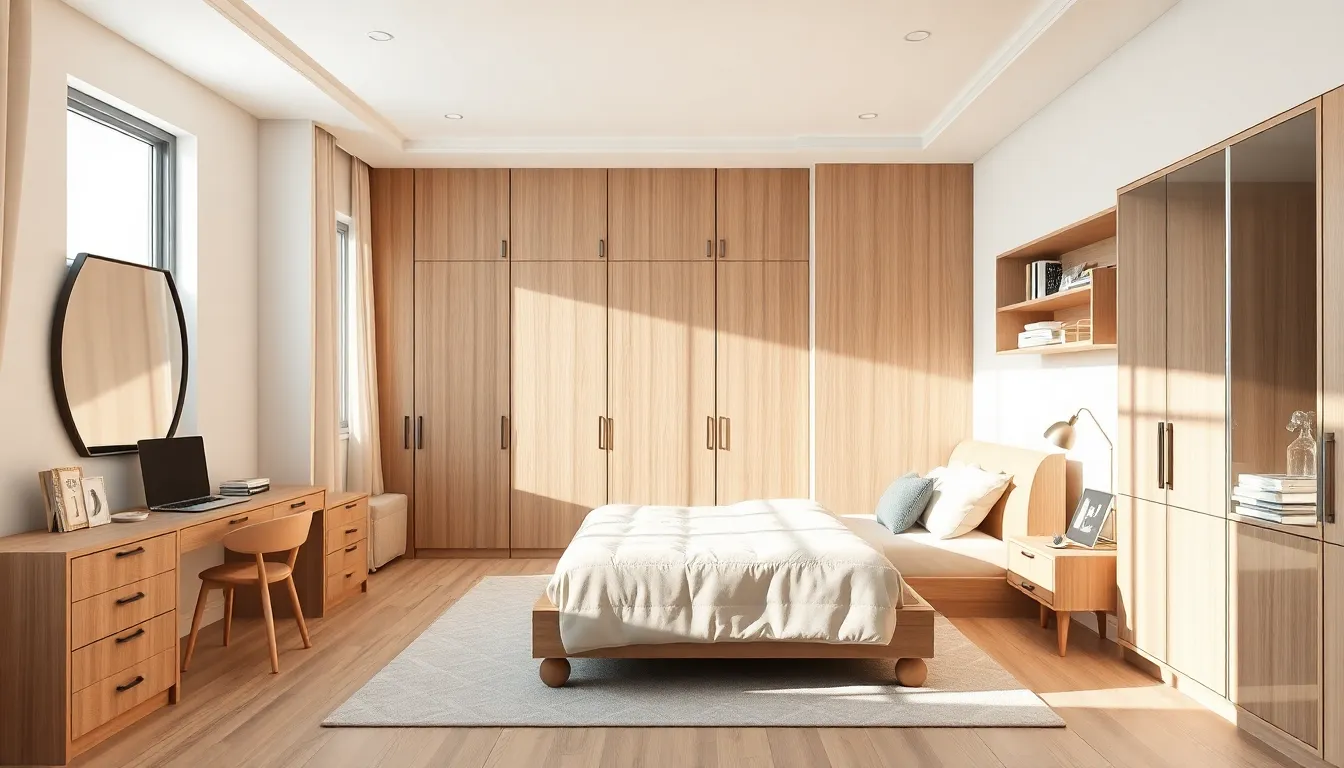
Table of Contents:
Design That Grows With Your Child
High-end children’s furniture should adapt to changing needs, not force families to replace it every few years. The strongest designs support several stages of childhood through adjustable parts, generous proportions, and a finish that still feels right as tastes mature.
Look first for furniture with a clear transition plan. A cot that converts into a toddler bed can extend its useful life. A daybed may later become a reading bench or guest bed. A dresser with a removable changing top can shift from nursery duty to everyday storage without looking like nursery equipment. These changes are most useful when the base frame stays stable and replacement parts remain available.
Size matters, too. A desk should leave enough legroom for growth, while an adjustable chair should offer firm support at different heights. Avoid pieces built around a narrow age range or a very specific theme. Soft colors, simple profiles, and replaceable textiles tend to age better than cartoon prints or oversized decorative details.
For a practical comparison, consider three questions before buying:
- Can the piece serve at least two clear purposes over time?
- Can worn or damaged parts be repaired or replaced?
- Will its scale and appearance suit an older child’s room?
Durability also depends on daily use. Check drawer runners, hinge quality, joint construction, and the stated weight limit. A beautiful wardrobe is not a lasting choice if its doors sag or its shelves cannot handle books. Longevity lives in these small engineering decisions, not just in the price tag.
Safe Materials and Child-Friendly Details
Safety is not a decorative extra. It is part of the design brief. In a premium children’s room, every finish, fastener, and opening should suit the way children touch, climb, pull, and explore furniture.
Start with verifiable material information. Solid wood, plywood, and engineered panels can all work well, but the label alone proves little. Ask for the exact finish, emissions data, and applicable safety certifications. For painted or lacquered parts, low-emission water-based coatings are often a sensible choice. Avoid vague claims such as “non-toxic” unless the maker explains how the claim was tested.
For children’s furniture sold in the United States, look for compliance with relevant Consumer Product Safety Commission rules. In Europe, products may fall under the General Product Safety Regulation, effective since December 13, 2024, as well as specific standards for cots, changing units, bunk beds, or seating. The correct standard depends on the furniture type. A certification mark should be traceable, not merely printed in promotional copy.
- Check for stable joints, secure hardware, and clear assembly instructions.
- Choose drawers with stops or anti-tip systems, especially on tall storage units.
- Inspect gaps that could trap fingers, limbs, clothing, or cords.
- Prefer recessed handles or rounded pulls over sharp projecting hardware.
- Confirm that bunk beds include suitable guardrails and the required mattress information.
- Anchor dressers, bookcases, and wardrobes to the wall with the supplied hardware.
Textiles deserve attention as well. Removable covers make cleaning easier, while tightly woven fabrics resist snagging. For mattresses and upholstered pieces, check flame-retardant treatment, chemical disclosures, and care instructions. Do not place loose cords, hanging mobiles, or climbable objects near a cot or raised sleeping surface.
Documentation is the quiet marker of quality. A responsible maker should provide production details, care guidance, weight limits, warnings, and replacement-hardware information. If those basics are missing, the furniture may still look refined, but its safety cannot be judged with confidence.
Smart Storage for Calm, Organized Rooms
Smart storage makes a premium children’s room easier to use because every object has a clear home. The goal is not to hide everything. It is to create a simple visual rhythm: daily items within reach, seasonal pieces higher up, and fragile objects out of the way.
Use storage by activity rather than by object type. A low basket near the reading area can hold picture books, while shallow drawers beside a desk suit pencils, paper, and small projects. Deep cupboards work better for bedding or bulky toys. This zoning reduces search time and helps children return items without turning tidying into a daily negotiation.
- Keep frequently used items between the child’s shoulder and knee height.
- Use open compartments for objects that need to be found quickly.
- Choose closed fronts for visual clutter, craft supplies, and spare bedding.
- Reserve the highest shelves for adult-managed items.
- Add labels or simple picture symbols before the storage system becomes crowded.
Proportion is where refined storage earns its keep. A wall-mounted cabinet can preserve floor space, but it should not dominate a narrow room. Modular cubes allow a layout to change without buying a whole new unit. Drawers under a bed can handle off-season clothing, yet they need enough clearance to open fully and remain easy to clean.
Plan for access, not just capacity. A storage unit that holds 200 books may be less useful than one that displays 20 covers and stores the rest elsewhere. Leave some empty space, too. A cabinet filled to the brim loses flexibility almost immediately; breathing room keeps the room calmer and makes future changes less fussy.
Before installation, measure door swings, skirting boards, heating vents, and walking paths. Then test the daily route from bed to wardrobe to play zone. Good storage quietly removes friction from that route, reducing visual noise and misplaced items while helping the room stay composed after a busy afternoon.
Beds That Balance Comfort and Space
A well-designed bed does more than provide a place to sleep. It can preserve floor area, support a restful routine, and give a room a strong visual anchor without making the space feel crowded.
Begin with the mattress, not the frame. Measure the exact mattress size required, then leave enough clearance for fitted sheets, ventilation, and easy cleaning. A slatted base should allow steady airflow beneath the mattress. A solid platform may look sleek, but it needs a carefully designed ventilation solution to prevent trapped moisture.
Room layout matters as much as bed design. Keep clear access on the side used for changing sheets, and avoid blocking radiators, windows, or wardrobe doors. In a compact room, a daybed with drawers can combine sleeping and lounging functions. A trundle adds a second sleeping surface, though it needs open floor space when pulled out.
Loft and bunk configurations can save valuable square footage, but they require stricter planning. Check the recommended minimum age, ceiling height, mattress thickness, guardrail height, and ladder position. The upper sleeping level should never sit so close to the ceiling that a child cannot sit upright comfortably. For younger children, a low single bed is usually the more practical choice.
- Choose a mattress with the correct firmness and dimensions for the child’s age.
- Measure the full footprint, including drawers, ladders, and pull-out sections.
- Leave a clear route for nighttime movement and emergency access.
- Check whether bedding can be changed without moving the entire frame.
- Review the maker’s instructions before adding a canopy, rail, or under-bed accessory.
The best high-end bed is not necessarily the largest or most dramatic one. It is the piece that fits the room’s geometry, supports comfortable sleep, and leaves enough space for the child to move, read, and play.
Flexible Furniture for Play and Learning
Flexible furniture should support two very different modes: focused work and open-ended play. The best pieces do this through movement, not gimmicks. A sturdy table can become a drawing station, a puzzle surface, or a place for building projects when its proportions leave room for changing activities.
Choose a work surface with enough depth for the task at hand. Around 55–65 cm is often more useful than a shallow console, especially when a child uses books, paper, and a laptop together. Lockable casters can add mobility, but they should hold firmly during writing or cutting. A folding top is convenient only when the hinges are smooth and the support mechanism is easy for an adult to inspect.
Modular elements bring another layer of flexibility. A tabletop with removable legs may later serve as a craft bench. A side panel can hold hooks, a roll of paper, or a small display rail. These additions should remain optional, so the room does not become tied to one learning method. Children change interests quickly—today’s art corner might be tomorrow’s robotics station.
- Use a table that allows more than one child to work without elbow-to-elbow crowding.
- Keep electrical cables away from cutting, painting, and water-based activities.
- Select wipeable surfaces for glue, clay, and felt-tip pens.
- Leave a clear zone around movable furniture so it can be repositioned without awkward lifting.
- Separate quiet study from noisy play when the room is shared.
Scale should follow the activity, not only the child’s height. A low table works well for floor-based construction and group play, while a higher desk supports drawing or digital work. Mixing both heights can create a small but versatile studio. It feels more natural than asking one surface to do absolutely everything.
High-end design shows its value when these changes feel effortless. Strong joinery, replaceable components, and neutral forms let furniture move between play and learning without looking temporary. That balance gives children freedom while keeping the room visually deliberate.
Elegant Styles for Baby and Kids’ Rooms
Elegant children’s rooms feel considered rather than overly themed. Their appeal comes from proportion, texture, and a restrained palette—not from filling every corner with decorative objects. This approach lets the room feel playful today and still feel credible a few years from now.
Begin with a visual language. Warm oak, pale ash, painted timber, woven cane, and brushed metal each create a different mood. Use one dominant material and one supporting texture across key pieces. Too many finishes can make even expensive furniture look pieced together; a quieter mix feels more intentional.
Color works best in layers. Soft clay, sage, cream, muted blue, and warm grey provide a calm foundation, while artwork, bedding, or a small chair can introduce stronger color. For a baby room, this creates a gentle setting without relying on stereotypical pink or blue. In an older child’s room, accents can change without replacing the main furniture.
- Choose silhouettes with clean lines and one memorable detail, such as a curved rail or fluted front.
- Repeat a color in small doses rather than matching every item exactly.
- Use natural texture to prevent pale rooms from feeling flat.
- Keep decorative themes portable through art, lampshades, and textiles.
- Balance playful forms with quieter architectural pieces.
Scale deserves special care. A large statement cabinet may suit a spacious room but overwhelm a nursery. Conversely, several tiny pieces can make an older child’s room feel unfinished. Place the strongest visual element where it can be seen clearly, then give surrounding furniture enough breathing room.
The most successful schemes also respect the home beyond the children’s room. A discreet palette and thoughtful detailing create continuity with adjoining spaces, while a single whimsical feature keeps the room distinctly young. The result feels polished rather than precious.
Multi-Use Pieces for Small Spaces
Small rooms need furniture that earns its footprint. A single well-planned piece can serve more than one role, but only when each function remains easy to use. Otherwise, “multi-use” becomes a clever label for an awkward compromise.
Consider a window seat with a lift-up lid, a compact console that opens into a craft surface, or a narrow cabinet with a fold-down front. These formats can add seating, storage, or workspace without consuming the room all day. The mechanism should feel smooth and solid, with no loose parts that can vanish under furniture.
Visual weight matters in tight spaces. Furniture raised on slender legs can make the floor appear more open, while one tall unit often uses wall area better than several scattered pieces. Choose a consistent depth where possible. A room feels calmer when cabinets, benches, and shelves align instead of creating a jagged obstacle course.
- Measure the usable footprint with doors, drawers, and panels fully open.
- Allow clearance for movement, cleaning, and carrying laundry.
- Prefer nesting tables or stackable stools when occasional seating is enough.
- Use a fold-away element only if it can be opened without moving other furniture.
- Keep one uninterrupted floor zone for play, stretching, or shared activities.
Small-space planning also benefits from vertical thinking. A shallow picture ledge can replace a bulky display cabinet. Peg rails can hold costumes, bags, or headphones without taking floor space. Yet do not cover every wall. Empty areas provide visual rest and make the room feel larger than its measurements suggest.
Before buying, sketch the room at scale or mark the furniture footprint with painter’s tape. Walk through the layout at different times of day. If the bed, wardrobe, or desk becomes difficult to reach, the design is not truly functional. The cleverest piece is the one that frees the room without adding daily fuss.
How to Choose Quality That Lasts
High-end furniture earns its price through measurable construction quality, not a fashionable label. Assess the piece as you would a small architectural element: inspect how it is made, how it can be maintained, and what happens when one component wears out.
Ask for a material schedule or technical sheet. It should identify the wood species or board type, veneer thickness where relevant, finish, hardware, and manufacturing location. A solid-wood frame is not automatically superior to well-made plywood; stability, joinery, and moisture control matter more than a single material claim.
Examine the parts that carry stress. Mortise-and-tenon or dowel joints usually offer a stronger basis than simple staples. Drawer boxes should have cleanly joined corners, while runners should open evenly without side-to-side play. Doors need hinges that can be adjusted after installation. These details predict how a piece will behave after years of use.
- Request care instructions before purchase, not after a spill.
- Check whether replacement hinges, runners, shelves, or covers can be ordered separately.
- Confirm the warranty period and learn which repairs it actually covers.
- Compare the delivered dimensions with the published dimensions, including trim and hardware.
- Look for batch, production, or model information that makes future support possible.
Finish quality can be judged in person. Run a hand over exposed edges and inspect corners in strong daylight. The surface should feel even, with no bubbling veneer, rough end grain, or visible filler around joints. For online purchases, request close-up photographs and a sample of the finish if color consistency matters.
Price should be considered as a service life, not a single checkout figure. A $1,200 dresser used for twelve years costs about $100 per year before maintenance; a cheaper unit replaced twice may offer less value.
Example Product: “Example product title” at $19.99
Example product title is presented at $19.99 under the oomph brand. However, no verified product description, dimensions, materials, safety information, intended age range, warranty, or assembly guidance is available. Its suitability for long-term use and its value as high-end children’s furniture therefore cannot be assessed responsibly.
The low price is not evidence of poor quality, but it is also not proof of a genuine bargain. Without reliable information about intended use and daily performance, the product should be treated as an unverified listing rather than a confirmed design recommendation.
Before buying, request the following information from the seller:
- Exact product type and intended use
- Overall dimensions and maximum load
- Materials, coatings, and country of manufacture
- Applicable safety tests or compliance documents
- Included parts, assembly steps, and required tools
- Cleaning instructions and replacement-part availability
- Delivery terms, returns, and warranty coverage
These details matter especially when the item is intended for sleep, seating, climbing, storage, or use by a young child. A product title alone cannot show whether the furniture fits a room, suits a particular age group, or meets the practical demands of family life. Clear specifications should come before a purchase decision.
Fazit: Choose Style, Safety, and Function in One Piece
High-end children’s furniture succeeds when its beauty supports daily life rather than competing with it. The final choice should feel calm in the room, intuitive for the child, and practical for the adults who clean, assemble, and maintain it.
Use a simple final check before ordering. Confirm the product’s intended use, current safety documentation, delivery access, assembly requirements, and return conditions. Then consider the room as a complete system: sleeping, dressing, playing, reading, and movement should all work together without forcing awkward compromises.
For the oomph listing Example product title, priced at $19.99, the available information is too limited to support a quality recommendation. Treat the item as unassessed until the seller supplies reliable documentation.
- Style: Choose a form that complements the room without becoming quickly dated.
- Safety: Require clear, product-specific evidence rather than broad marketing claims.
- Function: Check that the piece solves a real spatial or daily-use problem.
- Accountability: Prefer sellers who provide support, care guidance, and traceable product information.
The best purchase is rarely the most ornate one. It is the piece that remains useful after the novelty fades, fits the child’s real routine, and earns its place through thoughtful design. Style and functionality then become one considered decision.
Frequently Asked Questions About High-End Kids’ Furniture
What makes children’s furniture high-end?
High-end children’s furniture combines durable construction, carefully selected materials, refined design, practical features, and reliable safety information. Its value comes from long-term usability and thoughtful engineering rather than price alone.
How can children’s furniture grow with a child?
Furniture can grow with a child through convertible designs, adjustable components, generous proportions, and timeless finishes. Examples include cots that convert into toddler beds, removable changing units, adjustable desks, and adaptable storage.
What safety features should premium kids’ furniture include?
Important features include stable joints, secure hardware, rounded edges, anti-tip systems, safe gaps, suitable guardrails, clear weight limits, and traceable compliance documentation. Furniture should also be anchored according to the manufacturer’s instructions.
How can stylish furniture improve a child’s room?
Stylish furniture can create a calm, cohesive room while supporting sleep, storage, play, and learning. Neutral forms, durable materials, and replaceable textiles allow the room to evolve as the child’s interests and needs change.
What should buyers check before purchasing high-end kids’ furniture?
Buyers should check dimensions, intended use, materials, finishes, safety documentation, maximum load, assembly requirements, care instructions, warranty terms, return conditions, and the availability of replacement parts.